Blade Runner (1982)
a 1982 science fiction film directed by ridley scott, starring harrison ford, rutger hauer, sean young, and edward james olmos. an adaptation of philip k. dick’s 1968 novel do androids dream of electric sheep?, the film is set in a dystopian los angeles of 2019 where synthetic humans called replicants are bio-engineered by the tyrell corporation to work on off-world colonies. when a fugitive group of advanced replicants led by roy batty escapes back to earth, burned-out blade runner rick deckard is pulled out of retirement to hunt them down.
what the film does
los angeles, november 2019. the city is a rain-soaked, neon-lit industrial hellscape where japanese and western culture have fused into a polyglot street-level chaos. rick deckard (harrison ford) is a former blade runner, a cop who specialized in retiring replicants. he is brought back in by his old boss bryant because four nexus-6 replicants, the most advanced model yet, have escaped an off-world colony and returned to earth.
the replicants are roy batty (rutger hauer), the combat-model leader; pris (daryl hannah), a pleasure model; zhora (joanna cassidy), an assassin model; and leon (brion james), a manual-labor model. they are stronger and smarter than humans but have only a four-year lifespan, a built-in failsafe designed to prevent emotional development. they have come to earth seeking their creator, dr. eldon tyrell, hoping to find a way to extend their lives.
deckard begins his investigation at the tyrell corporation, where he meets rachael (sean young), a replicant so advanced she does not know she is not human. she has implanted memories, photographs of a childhood that never happened. deckard administers the voight-kampff test, a lengthy empathy-detection protocol, and discovers what she is.
the hunt leads deckard through the city: he kills zhora in a crowded street after she crashes through plate-glass storefronts with a bullet in her back, a scene that is among the most brutal in the film. he kills leon after leon nearly beats him to death in an alley, saved only by rachael shooting leon in the head. he returns to his apartment, drinks heavily, and sleeps with rachael in a scene that is uncomfortable by design, the film’s noir DNA surfacing in the power dynamics between a man who knows a woman is a replicant and a woman who is just discovering what she is.
batty and pris infiltrate the apartment of j.f. sebastian, a genetic designer for tyrell who has a condition called methuselah syndrome that causes accelerated aging. sebastian is sympathetic to the replicants, he understands what it means to have a body that is failing you. he brings batty to tyrell. batty asks tyrell to extend his life. tyrell refuses. batty kisses tyrell, then crushes his skull. he kills sebastian too.
the final confrontation takes place in the decaying bradbury building. deckard hunts batty through the halls while batty, whose body is shutting down, toys with him. deckard ends up dangling from a rooftop girder, about to fall. batty catches him. then, in one of the most memorable monologues in cinema, batty delivers his tears in rain speech, a four-year life distilled into a handful of images, and dies. deckard watches, silent. a replicant just showed him more humanity than any human in the film.
deckard returns to his apartment to find rachael alive. gaff, another blade runner, has left an origami unicorn outside the door, a signal that he let her live. they leave together. the film ends on an elevator door closing, ambiguous about whether deckard himself is a replicant, a question scott has answered differently in every interview he has ever given.
why it’s in the canon
criteria blend is 1+3, loved it and want to remember it. blade runner is one of the foundational texts of modern science fiction cinema. it established the visual language of cyberpunk before the genre had a name: perpetual rain, neon reflected in puddles, flying cars advertising off-world colonies, and a city where every surface is layered with decades of grime and advertising. the production design by lawrence g. paull and the cinematography by jordan cronenweth created a future that looks lived-in rather than designed, a quality that influenced everything from akira to the matrix.
the film is also a masterclass in what a soundtrack can do. vangelis’s score, built on the cs-80 synthesizer, is not a typical orchestral film score. it is ambient, melancholy, and occasionally terrifying. the love theme and the end titles are some of the most haunting pieces of film music ever recorded. the soundtrack was not officially released until 1994, twelve years after the film, which only added to its mythology.
rutger hauer’s performance as roy batty is the film’s soul. batty is the villain but he is also the most human character in the story. his final speech, which hauer improvised in part, reframes the entire film in its last two minutes. a machine that has killed five people to survive one more day looks at his dying hands and chooses to save the man sent to kill him. it is the only genuinely redemptive act in the film, and it comes from the thing that is not supposed to have a soul.
the film’s production history is almost as interesting as the film itself. the theatrical cut included a noir-style voiceover narration that ford recorded under protest, and a happy ending stitched together from outtakes of the shining. the director’s cut in 1992 removed both and added the unicorn dream sequence. the final cut in 2007 is the definitive version, the only one over which scott had complete artistic control. the fact that seven distinct versions of this film exist is a reminder that the version you saw first shapes your relationship to the film more than any critical consensus.
blade runner is also the film that brought philip k. dick to hollywood’s attention, leading to adaptations of total recall, minority report, a scanner darkly, and the man in the high castle. without blade runner there is no dick renaissance in film, and without that, a significant strain of paranoid, reality-questioning science fiction never makes it to the screen.
a note on the image
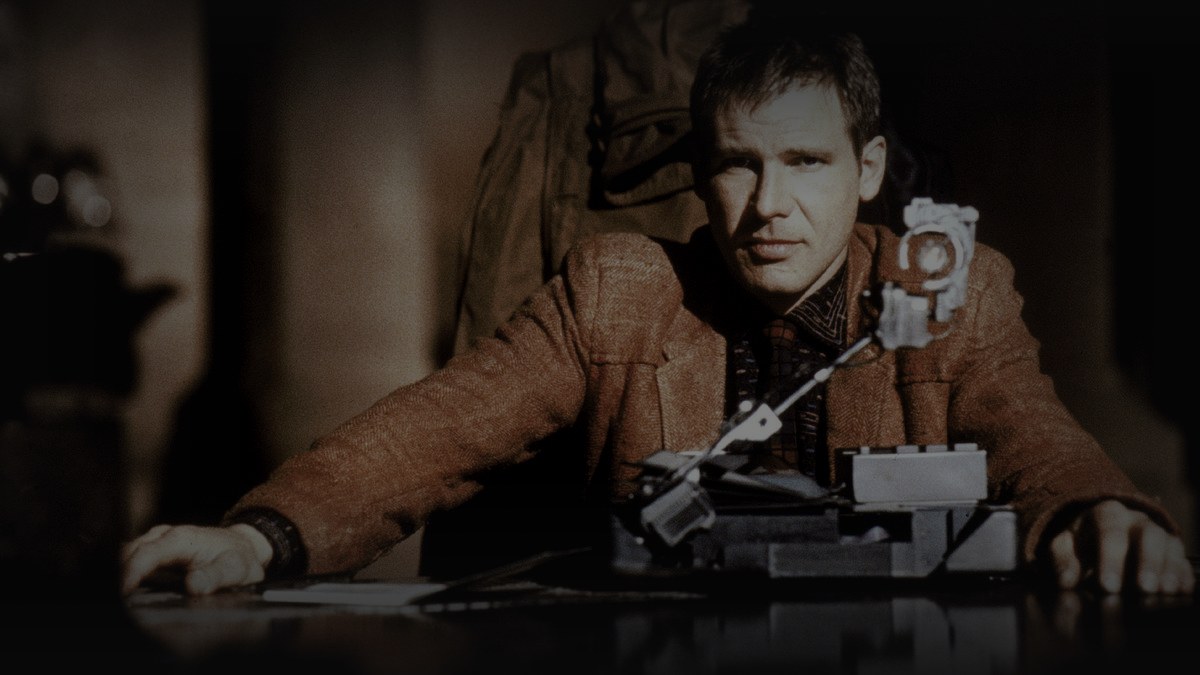
the hero image is a 16:9 still from letterboxd showing rick deckard using the esper machine at his apartment. the source image had mean brightness 79.9; baked at the default factor 0.45 to output brightness 30.1, inside the 25-35 canon daylight range.
on hand
yes, dvd. the 2007 final cut is the version to own. the theatrical cut exists as a historical artifact, an object lesson in how a studio can take a masterpiece and bolt a happy ending and a voiceover onto it, but the final cut is the film scott intended.
image: letterboxd (og:image, 1200x675 crop), baked through scripts/bake_dark_photo.py at factor 0.45, output brightness 30.1