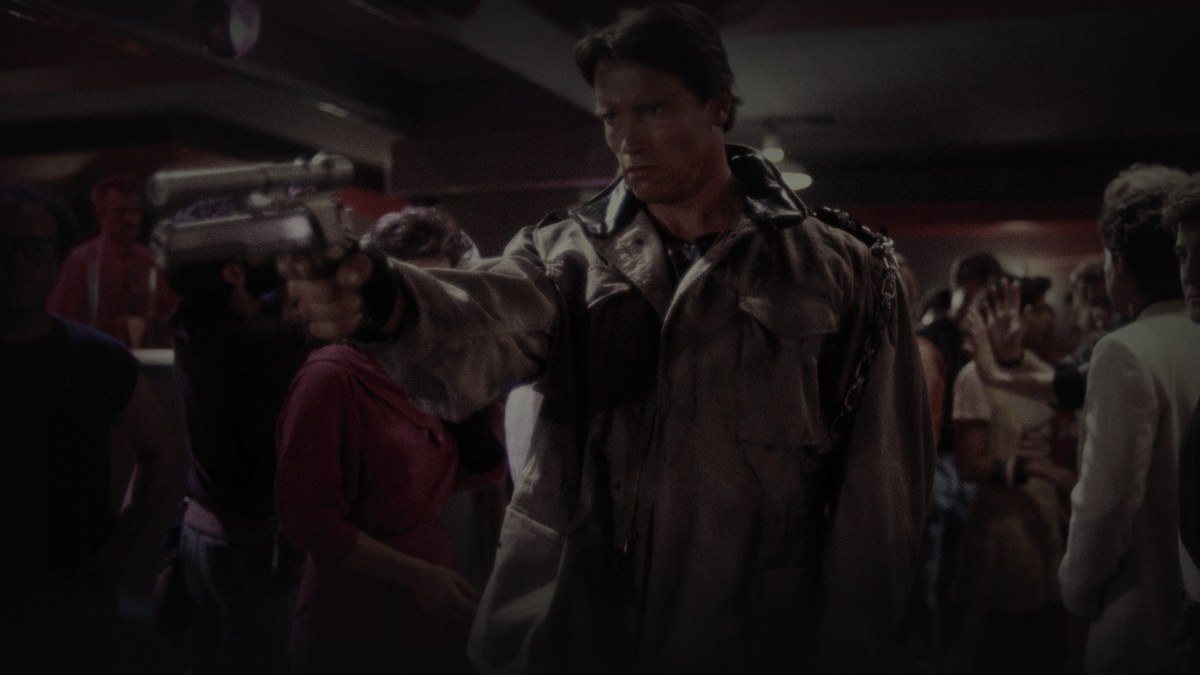
the terminator opens with the end of the world. in 2029, skulls are crushed under tank treads while hunter-killer drones sweep the rubble for human heat signatures. but that is the framing, not the story. the story begins in 1984 los angeles, where a naked man drops out of an electrical storm in an alley and tears through three punks for their clothes. he is not a man. he is a cybernetic organism, living tissue over a metal endoskeleton, sent back through time with one directive: terminate sarah connor.
sarah is a waitress. she does not know she is the mother of the future. she does not know that her not-yet-conceived son will one day lead the human resistance against skynet, the defense network that became self-aware and decided humanity was the threat. she only knows that someone is killing every sarah connor in the phone book, and a man with scars on his face keeps watching her from across the street.
that man is kyle reese, a soldier from the same ruined future, sent back to protect her. he is malnourished, half-mad from a childhood spent hiding from machines in the ash, and he has been in love with sarah connor since the moment john connor gave him her photograph. his entire life, from the extermination camps to the time displacement chamber, has been a straight line toward this woman in this diner. he does not know how to be gentle. he only knows how to fight.
what follows is the tightest chase film ever made. the terminator cannot be stopped. you can shoot it, run it over, blow it up, and it keeps coming. first as schwarzenegger’s impossible physique, then as a limping mass of torn flesh and exposed metal, and finally as a chrome skeleton clawing forward with one functioning arm. every time you think it is dead, it rises. the film refuses to let you breathe.
cameron shot most of it at night in downtown los angeles, working with a budget that would barely cover the craft services on T2. the stop-motion endoskeleton was animated by hand in a garage. the terminator’s vision, infrared with targeting reticles and threat-assessment readouts, was created with a waveform monitor and a character generator, a hack so simple it loops back around to genius. brad fiedel’s score is a metronome in a thunderstorm, five notes hammering over and over until your pulse locks to the tempo.
the film knows exactly when to slow down. the motel scene, where reese finally tells sarah why he came back, is the emotional core of the whole franchise. he crossed time because he loved a woman he had never met, and now that he has met her, the only thing he can give her is a few hours in a cheap room before the machine finds them again. she asks him what the women of his time are like. he says, “good fighters.” the next morning she is pregnant, and he is dead.
the terminator ends where it began: with a storm on the horizon. sarah is alone in mexico, pregnant, recording cassette tapes for the son she will raise to be a general. a boy takes her picture at a gas station, the same photograph reese carried through the camps, the photograph that made him volunteer for a one-way trip into the past. the loop closes. the storm clouds roll in. she says, “there’s a storm coming.” and then she drives into it.
this is the film that launched cameron’s career and proved schwarzenegger could act by barely speaking. it cost six million dollars and changed the way action films are structured. every story about an unstoppable pursuer, from T2 to it follows, owes something to what cameron figured out here: that the scariest thing in the world is not a monster that is fast. it is a monster that is slow, patient, and never anything but inevitable.
image: letterboxd (1200x675 still, baked 0.45, output brightness 20.8)